
Helping Former Forest Loggers Access Alternative Livelihoods
Everyone would be happy if as long as they lived, they could always breathe refreshing air. Also clean water is abundant and can be used at any time. As well as pleasant green views and a sense of security from the threat of ecological disasters because nature and the environment are still preserved. But what if a pleasant life is faced with the situation that nothing can be served at the dinner table? Not to mention the pressing costs of children's education and health services for all family members.
This situation is often found in communities around forest areas. This occurs due to limited economic access, level of education, and knowledge of sustainable forest use. This is also what makes logging activities in the forest a livelihood option. If one chainsaw can uproot hundreds of trees in a year, imagine the impact on the forest ecosystem if some communities on the edge of the forest make logging activities their economic source.
ASRI realizes that an economic approach is the right way to keep forests sustainable. Therefore, on Monday, July 4 2022, through its replication program in the supporting villages of the Bukit Baka Bukit Raya National Park, the Chainsaw Buyback program was launched.
Chainsaw Buyback Coordinator at the ASRI-Bukit Baka Bukit Raya Replication Program, Martinus Jihan, said that this program was initiated so that tree loggers can stop logging in the forest without neglecting their economic interests by turning into Micro, Small and Medium Enterprises (MSMEs). ASRI runs this program with collaboration from the Bukit Baka Bukit Raya National Park Office and funding support from the Tropical Forest Conservation Act – Kalimantan (TFCA-K).
This program begins with outreach among the community about the negative impacts of destroying forests and alternative jobs that can be done apart from logging activities. As well as explaining the existence of this program. Then loggers were approached directly to become ASRI partners in this program.
Loggers who want to switch jobs to become MSMEs are also given assistance in business planning. After that, the chainsaw used for felling was handed over to ASRI and witnessed by representatives of the Bukit Baka Bukit Raya National Park Office. Accompanied by the signing of an agreement not to return to the forest to cut down. After that, business capital will be provided and business assistance ranging from business planning, financial management, to marketing will be routinely carried out by ASRI.
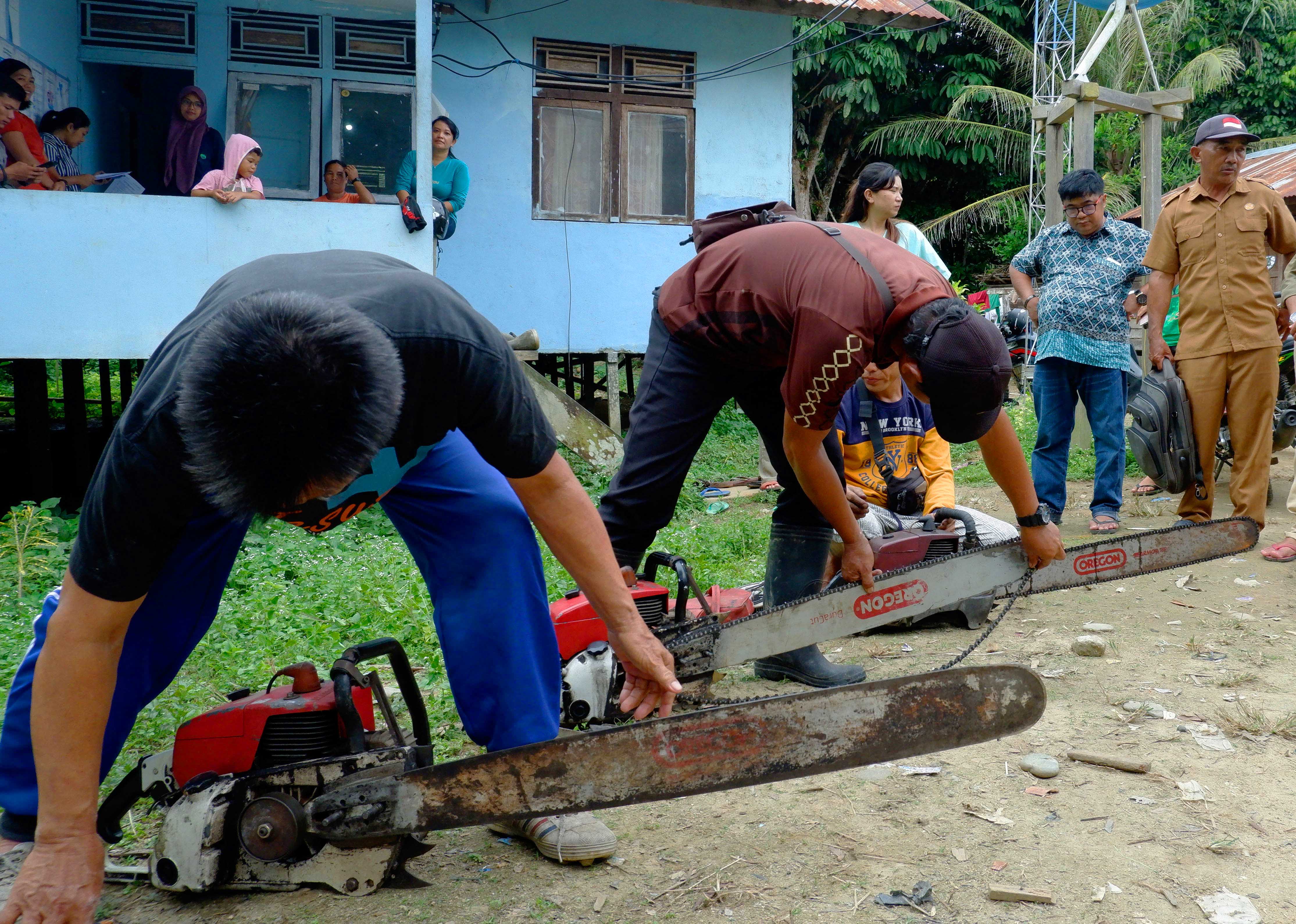
At the launch of the chainsaw buyback program, 3 loggers from Nusa Poring Village decided to join. When handing over the chainsaw and signing the agreement, representatives of the Bukit Baka Bukit Raya National Park Office, the Head of Nusa Poring Village, and ASRI staff were present. Chainsaw buyback participants are also accompanied by their respective wives so they can also participate and be involved in business development, as well as being witnesses that their husbands will not return to logging.
One of them is Bulang Heroni who comes from Mengkilau Hamlet, Nusa Poring Village. After decades of going back and forth through the forest and being an active logger, he has now handed over his chainsaw to ASRI and been given business capital to raise chickens and fish. He also became one of the first people to take part in the chainsaw buyback program. “I have to be an example for society. "So that people can realize that there are other jobs that can provide food," he said.
Bulang is now also aware of the impact on the forest when he decided to switch livelihoods. Therefore, he also fully supports the objectives of the program initiated by ASRI in collaboration with the Bukit Baka Bukit Raya National Park to protect the forest while improving the welfare of this community. Bulang also hopes that the choices he makes can be followed by the community.
“If we want to be an example, we have to start first. "Then I also gave a good example to the community on how to protect the forest by completely stopping logging and focusing on starting my business," said the father of 4 children.
The same choice was also taken by Luwi, who comes from Sekujang Hamlet, Nusa Poring Village. He also said that working in the forest was full of risks, cost a lot of money, and was hard work that was physically draining. After handing over his chainsaw to ASRI, he is now starting his new job running a grocery stall. "I promise to follow all agreements not to cut anymore and focus on my basic food business," said the man who once served as Head of Sekujang Hamlet.
ASRI has previously implemented this chainsaw buyback program in villages supporting the Gunung Palung National Park in Sukadana, North Kayong since 2017. As of July 20 2022, 234 chainsaws have been handed over to ASRI and it is estimated that tens of thousands of trees in the forest will be saved.
ASRI also wants to repeat the same success in its replication program in the supporting villages of the Bukit Baka Bukit Raya National Park. Martinus Jihan again said that through this program, it is hoped that there will be a change in mindset in communities around forest areas that to support themselves and their families they do not have to be loggers in the forest which has many risks such as safety risks and the risk of breaking the law.
"By handing over chainsaws, people can start becoming MSME actors, whether in trade, production or services with the capital provided by ASRI. Then receive regular business assistance. "Protecting forests while ensuring the welfare of communities around forest areas can also be done," he said.
 copy.jpg)
Meanwhile, Daily Executive (Plh) of the Bukit Baka Bukit Raya National Park Office, Doni Maja Perdana, said that the collaboration between the Bukit Baka Bukit Raya National Park Office and ASRI in the chainsaw buyback program was the right step from the aspect of regional sustainability and the welfare of the people around the area. . “This program can reduce loggers taking wood in National Parks. This is good because the logger not only exchanges the chainsaw, but the logger is also given an incentive to start a new job to replace his old economic resources. "That way, this former logger will not return to his old job collecting wood in the forest," he said.
He also said that people around the area could continue to use non-timber forest products (NTFPs) in the Bukit Baka Bukit National Park. In this way, the Bukit Baka Bukit Raya National Park can benefit the welfare of the community, while still being able to preserve nature and biodiversity within it.


