Looking for the Presence of Wildlife with a Camera Trap
What is a “camera trap”? Maybe some of us have just heard this term. Don't get the wrong idea, because this camera is not used to trap or catch animals, but only to photograph and record the presence and activities of wild animals in an area. Current technological advances have made various activities in the field easier, including observing and surveying wild animals using camera traps.
Initially, the concept of using a camera trap was first discovered by George Shiras in the 1890s by using a trap wire which would trigger a trigger on the camera when the target animal touched the wire. The method used by George Shiras was then adapted and continues to develop rapidly today. Tappan Gregory in 1927 then developed the Shiras method by adding magnesium powder as a flash to be able to photograph animals more clearly. Gysel and Davis (1956) developed a camera trap powered by a 6V battery, Pearson (1959) developed a two-trigger system without using a trap wire, until Carthew and Slater (1991) and Mace (1994) used an automatic camera trap with an infrared light trigger. Until now, camera trap technology continues to develop rapidly, currently there are even camera traps available with WiFi and Bluetooth features which enable surveyors to view photos or recordings of animals directly and in real time via devices or applications on their smartphones/computers. -each.
Currently, the use of camera traps has been widely applied for survey and research activities on wildlife throughout the world, including in Indonesia. The camera trap system works without the presence of a photographer, is automatic, and will only actively record if there is animal movement or body temperature detected by the sensor on the camera. In general, camera traps have two types of sensors, namely motion sensors and heat sensors. The use of camera traps makes it very easy for surveyors to observe and monitor the presence of wild animals, especially types of animals that are nocturnal (active at night), shy and tend to avoid encounters with humans. Installing camera traps can be carried out for 2-6 months with continuous activation for 24 hours, so that they can replace the role of humans in observing wild animals. Camera traps are also able to save time, costs and energy required for intensive wildlife survey activities even though the price of each type of camera trap is quite expensive based on the features it has.
The choice of location and installation of camera traps cannot be done haphazardly. There are many considerations that need to be taken to install a camera, such as the method used, the type of target animal, and signs that indicate the presence of animals in that location (tracks, water sources, food sources, feces, fields, nests, etc.) . Regarding the installation of camera traps, we usually install cameras at a distance of 500 m between cameras and installation is done by tying them to trees at a height of 30 – 40 cm above the ground. In this way, several things can be known, such as the types of wildlife that exist, their distribution or distribution, and data on various other scientific components.
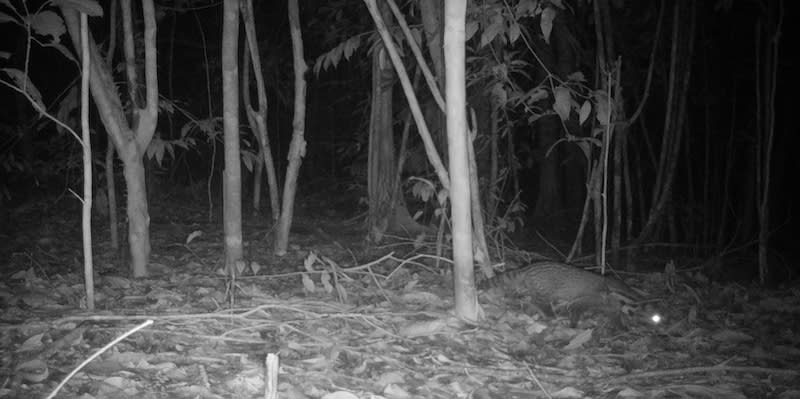
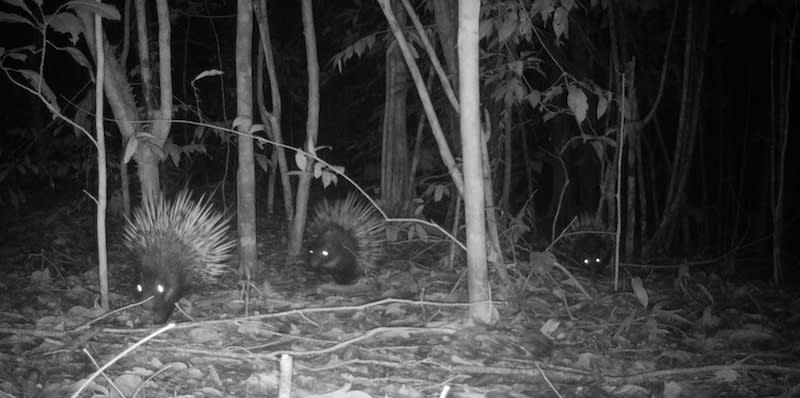

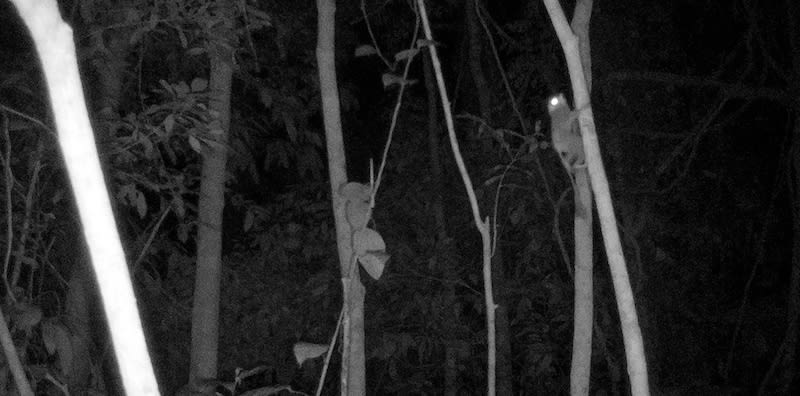
Seeing the efficiency and ease of using camera traps, ASRI has also begun to apply the use of camera traps over the last few years to monitor the presence of wild animals that appear in the reforestation areas carried out by ASRI in Sedahan and Laman Satong which are also areas of the Gunung Palung National Park (TNGP). . The results obtained can be said to be quite interesting because several wild animals were found recorded by camera traps, including orangutans (Pongo pygmaeus), tarsiers (Cephalopachus bancanus), tenggalung civets (Viverra tangalunga), and Malayan porcupines (Hystrix brachyura).
The existence of these wild animals in the reforestation area has become an indicator that the reforestation efforts carried out by ASRI together with TNGP are going well. Slowly, areas that were originally open and degraded can now return to forest and become a new home for these wild animals. Furthermore, a lot of information collected from these camera traps can be used to determine appropriate conservation strategies to protect these wild animals from becoming extinct and ensure that reforestation efforts can continue to run well to provide forest areas as ideal habitat for these wild animals. the wildlife.

Short profile:
Currently, Sandy works at ASRI as a Research and Database Assistant who is fully responsible for the program database and various research activities at ASRI, including camera traps. Sandy graduated with a Masters in Environmental Science from the University of Indonesia with expertise in conservation, climate change, ecosystem services, ecology, anthropology of Dayak Indigenous Peoples, and sustainable development. Since 2015 until now, Sandy has been actively involved in various research activities and has explored several forest areas in Sumatra, Java and Kalimantan.
Instagram: @sandyleo_22